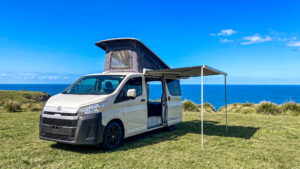
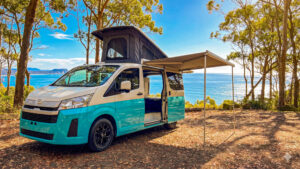
Quick answer: A pop top campervan is lower, easier to park and usually cheaper to run, with headroom when you raise the roof. A high-top gives you standing room all the time and suits long trips in cold weather, but it’s taller and harder to live with in town. For most couples doing weekends and touring, a pop-top is the easier van to own.
Once you’ve settled on a van, the roof is the next big call. It decides where you can park, how you sleep, how the van drives on a windy highway and how it feels inside on a wet afternoon.
We built a pop top campervan on the Toyota HiAce, so we’ve got skin in the game. Even so, this guide lays out the trade-offs plainly, so you can pick the roof that suits how you actually travel.
Pop-top vs high-top campervan at a glance
| Pop-top | High-top | |
|---|---|---|
| Travel height | Close to a standard van. Our HiAce H300 pop-top is listed at 2.065m | Taller. A factory HiAce SLWB high roof is 2.28m before any fit-out |
| Standing room | Only with the roof raised | All the time |
| Car parks and garages | Fits more of them | Often too tall for multi-level car parks |
| Extra bed | Optional roof bed in many builds | Usually no roof bed, but more storage up high |
| Insulation and noise | Canvas sides let in more cold and sound | Solid walls, warmer and quieter |
| Setup | Unlatch and push up, around a minute | Nothing to set up |
| Wind and fuel | Lower profile, less drag | More side-on to crosswinds and more drag |
| Stealth camping | Roof down, it looks like a van | Easier to pick as a camper |
Pop top campervan: pros and cons
A pop-top has a hinged roof section that lifts up, with fabric sides that fold away when you lower it. Down, you’re driving something close to a normal van. Up, you can stand at the sink and cook.
The pros
- It fits where you live. Low clearance is the big one. Shopping centre car parks, city streets and many home garages are far easier when the roof sits low.
- It drives like a van, not a box. Less height means less drag and less push from crosswinds. On a gusty stretch of the Pacific Highway, you’ll notice.
- Fresh air on tap. Opened up, the canvas and windows pull a breeze through the van on warm nights. Our pop-top has three windows for exactly this.
- Room for a third sleeper. Many pop-tops can take a roof bed. On a Coastal Campers van it’s an optional extra, rated to 120kg, so it’s handy for a child or for stashing gear.
- Low-key looks. With the roof down, nobody gives you a second glance in a quiet street.
The cons
- Canvas isn’t a wall. It lets in more cold and more noise than solid sides. Think winter in the Snowies or a campground next to the highway.
- Wet weather takes thought. Packing the roof down wet is fine for a drive, but open it again soon after so the fabric dries.
- No standing room on the move. If you want to stand up at a rest stop, the roof goes up first.
- Wind limits. In strong wind you may prefer to keep it down, which means sitting rather than standing.
High-top campervan: pros and cons
A high-top is built on a tall-roof van, or has a fixed fibreglass roof added. On the HiAce, that usually means the super long wheelbase (SLWB) high roof, which is 2.28m tall and 5.915m long straight from the factory.
The pros
- Stand up any time. Rain, wind, a quick stop for lunch. No roof to raise.
- Warmer and quieter. Solid, insulated walls hold heat better in winter and keep road and campground noise out.
- More storage up high. Overhead cupboards can run the length of the van.
- Better for long stretches on the road. If you’re living in the van for months, being able to stand without thinking about it adds up.
The cons
- Height rules out a lot. Many multi-level car parks, some drive-throughs and most home garages are off the list. Always check the signed clearance.
- A bigger van to drive. The SLWB is 650mm longer than the standard HiAce, so parking and tight streets take more care.
- Crosswinds and fuel. A taller, flatter side catches more wind and adds drag.
- Less ventilation. Without opening sides, you’ll lean more on a roof fan.
- It looks like a camper. Fine at a caravan park, less so for a quiet overnight stop.
How the roof changes Toyota HiAce campervan layouts
The roof shapes everything underneath it. Most Toyota HiAce campervan layouts on the standard-length van are built around a pop-top, because it adds headroom without adding length or travel height.
In a pop-top layout, you’ll usually find:
- A rear seat that becomes the bed. In our van, the rear seat folds into a full-length bed for two adults and has integrated seatbelts, so it’s certified for travel too.
- An open floor by day. With the bed folded away, there’s space to move, sit and eat. A swivel passenger seat and an inside/outside table make the cab part of the living area.
- A kitchen along one side. Cooking happens under the raised roof, where you can stand. Ours has an induction cooktop, a stainless steel sink and an 83L 12V fridge-freezer.
- Optional roof bed. Sleep a third person up top or use it as a loft for bedding.
High-top layouts tend to go the other way. With headroom everywhere, builders often fit a fixed bed across the back, a taller pantry and overhead lockers. You gain storage but lose the daytime floor space a convertible bed gives you.
Why the HiAce H300 suits a pop-top
The HiAce H300 is the sixth-generation HiAce, and it’s a big reason the Toyota camping van has become so popular in Australia. The standard long wheelbase version is 1.99m tall and 5.265m long. Add a pop-top and it stays low enough for everyday driving, with the headroom of a much bigger van once you’re parked.
Here’s how the H300 we build on stacks up:
| Spec | Coastal Campers HiAce H300 pop-top |
|---|---|
| Engine | 2.8L 4-cylinder turbo diesel |
| Power and torque | 130kW and 450Nm |
| Transmission | 6-speed automatic |
| Fuel use | 7.4L/100km combined, 70L tank |
| Length / width / height | 5.265m / 1.950m / 2.065m |
| GVM | 3,300kg (tare approx. 2,450kg) |
| Safety | 7 airbags, adaptive cruise, pre-collision system, lane tracing assist, blind spot monitor |
It’s also a Toyota, which matters a long way from home. There are Toyota dealers right around the country, and the van comes with Toyota’s 5-year factory warranty.
Which roof suits how you travel?
Forget which roof is better in general. The useful question is which one fits the trips you’ll actually take.
- Weekenders and short breaks: Pop-top. You’ll drive it to work, park it at the shops and take off on Friday afternoon without thinking about clearance.
- Couples touring the coast: Pop-top. Warm-weather trips, beach car parks and coastal towns suit a lower van, and the breeze through the canvas is a bonus.
- Families with a young child: Pop-top with a roof bed. It gives you a third sleeping spot without moving up to a bigger vehicle.
- Full-time or cold-climate travellers: High-top. If you’re living in it through a Tasmanian winter, solid walls and constant headroom earn their keep.
- City dwellers with a garage: Pop-top, almost every time. Measure your garage door first either way.
Still torn? Spend a night in each if you can. Ten minutes inside both will tell you more than any spec sheet.
Looking at a HiAce campervan for sale? Check the roof first
Whichever roof you lean towards, these checks are worth doing on any HiAce campervan for sale, new or used:
- Raise and lower it yourself. It should go up smoothly and latch securely without a wrestle.
- Look at the canvas and seals. Check for mold, tears, perished zips and gaps around the roof frame.
- Look for water marks. Stains on the headliner or cabinetry point to a leak.
- Ask about the roof cut-out. On used vans, check for rust around the opening and ask who did the work.
- Confirm compliance. The roof and any seats used for travel should be certified. Ask for the paperwork.
- Ask about the warranty. Our conversion warranty covers cabinetry, roof and bed lining for 5 years, on top of Toyota’s 5-year factory warranty. Whoever you buy from, get the terms in writing.
- Measure your clearances. Know your garage and regular car park heights before you buy.
For more on new vs used, costs and inspections, read our Toyota HiAce campervan buying guide.
See a pop-top in person
Coastal Campers is a certified second-stage manufacturer, building brand-new HiAce H300 pop-tops from $97,950 drive-away (delivery extra). Come and raise the roof yourself at our West Gosford NSW or Southport QLD showroom, or see real builds in our gallery. When you’re ready, take a closer look at the van or call 1300 315 266.
Pop-top vs high-top campervan FAQs
Is a pop top campervan better than a high-top?
Neither is better across the board. A pop-top is lower, easier to park and better for everyday driving. A high-top gives constant standing room and better insulation, which suits full-time or cold-weather travel.
Can you stand up in a pop top campervan?
Yes, once the roof is raised. You can stand in the kitchen and move around inside. With the roof down you’ll be sitting, so it’s worth raising at any longer stop.
Will a pop top HiAce fit in a car park?
Often, yes. Our HiAce H300 pop-top is listed at 2.065m tall, lower than a factory HiAce high roof at 2.28m. Clearances vary, so always check the signed height first.
Are pop-top campervans cold in winter?
They can be cooler than a high-top, because the raised sides are fabric rather than solid walls. With the roof down overnight, good bedding and a sensible campsite, plenty of owners travel year-round.
How many people can sleep in a HiAce pop-top?
In a Coastal Camper’s HiAce, the rear seat folds into a full-length bed for two adults. An optional roof bed, rated to 120kg, adds space for a child or extra gear.