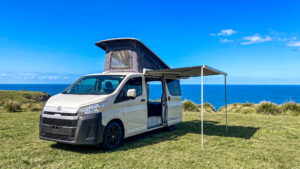
Buying a campervan in Australia is exciting right up until you start comparing them. Suddenly you’re weighing up new against used, pop-tops against high-tops, and prices that seem to be all over the place.
This Toyota HiAce campervan buying guide is for anyone who’s settled on the HiAce, or is close to it, and wants to buy with their eyes open. We’ll cover why it’s such a popular base, the real trade-offs between new and used, roof and layout choices, what it actually costs to get on the road, and the checks worth doing before you hand over a deposit.
We build on the HiAce ourselves, so where it helps we’ll use our own Toyota HiAce campervan as a worked example. The aim, though, is to help you pick the right van, whoever builds it.
Why is the Toyota HiAce so popular as a campervan base?
In short: it’s reliable, it’s easy to get serviced almost anywhere in the country, and the current H300 model drives more like a big SUV than a delivery van.
That last point surprises people. The sixth-generation HiAce H300 is a genuinely comfortable thing to spend a long day behind the wheel of, with modern tech like an 8″ touchscreen with sat nav and wireless Apple CarPlay and Android Auto. In the version we build on, it’s a 2.8L four-cylinder turbo diesel making 130kW and 450Nm, paired with a 6-speed automatic and using around 9L/100km because of the weight of the van.
The safety list is strong for a van, too. It has seven airbags, adaptive cruise control, a pre-collision safety system, lane departure alert, lane tracing assist, blind spot monitoring, rear cross traffic alert and a reversing camera. After a full day of driving, those features really do take some of the strain out.
Then there’s the dealer network. Toyota has dealers right across Australia, so if something needs looking at in Broome or Bundaberg, you’re not stuck waiting for a specialist part from the other side of the country. For a vehicle you plan to take a long way from home, that peace of mind is worth a lot.
It isn’t perfect. A converted HiAce is a compact camper, not a motorhome, so you’re trading floor space for a van that’s easy to drive and park. For most couples and weekenders, that’s a trade worth making.
New vs used campervan: which way should you go?
There’s no single right answer here. It comes down to budget, how much risk you’re comfortable with, and how much time you want to spend on paperwork.
Buying used
A used HiAce campervan can save you money up front. How much depends on the van’s age, its kilometres and the quality of the fit-out.
The savings come with homework, though. You’ll want to know who did the conversion, whether it was certified, how the electrics were done, and whether the van has been kept under its GVM. Ask about service history, rust around any roof cut-outs, and water damage in the cabinetry. A cheap van that needs recertifying or rewiring stops being cheap very quickly.
Buying new
A camper van new from the builder costs more, but you’re paying for certainty. You know exactly what’s been fitted, the compliance paperwork is done before you collect it, and you’re covered by warranties on both the vehicle and the conversion.
New also means you get a say. Options like a lithium battery upgrade, roof solar or a lift kit can be built in from the start, which is far cheaper than retrofitting later.
The hidden costs people miss
With used vans, it’s the surprise repairs and the recertification if the paperwork isn’t there. With new vans, it’s the optional extras that add up and the delivery charge if you’re not collecting in person. Either way, ask for the full, final price in writing before you commit.
Pop-top vs high-top campervan: which roof suits you?
The pop top vs high top campervan debate really comes down to how you’ll use the van day to day.
A pop-top keeps the van close to its standard height when the roof is down, which matters more than you’d think. On our HiAce, the standard-roof height is 2.065m, so it still feels like a regular van in town, at the shops and in plenty of car parks. Pop the roof at camp and you get standing room, plus airflow through the roof windows. The trade-off is that you raise and lower it each time, and the canvas sides offer less insulation in the cold.
A high-top gives you permanent standing room and more space for overhead storage, with no setting up. But the extra height rules out a lot of car parks and some drive-throughs, and it can catch crosswinds on the highway.
| Pop-top | High-top | |
|---|---|---|
| Standing room | When raised | Always |
| Everyday driving and parking | Easier | Height limits apply |
| Insulation | Less (canvas sides) | More |
| Set-up at camp | Raise the roof | None |
| Suits | Weekenders, daily drivers, mixed use | Long trips, colder climates |
If the van doubles as your everyday car, a pop-top is usually the easier one to live with. If you’re heading off for months at a time, a high-top’s permanent space starts to look very appealing.
What to look for inside a HiAce campervan
Photos can make any layout look roomy. The real test is how it works when you’re tired, it’s raining and you’ve got wet gear to stash. Here’s what to check.
The bed. Lie on it. Seriously. Check the length, how long it takes to convert from seat to bed, and whether you have to unpack half the van to do it. In our build, the rear seat folds into a full-length bed for two adults, and it carries integrated seatbelts so it’s certified for travel too.
The kitchen. Think about how you actually cook. Induction is clean and simple to run with no gas bottles, but it relies on a good electrical system. Look at the sink, the bench space, and whether the fridge is big enough for more than a couple of days. Ours runs an 83L fridge freezer, which comfortably handles a long weekend.
Water. Check the fresh water tank size and whether there’s an external shower. A 50L tank, which is what we fit, covers drinking, cooking and quick rinses for a couple of days if you’re careful.
Storage. Count the drawers and cupboards, then picture your gear in them. Soft-close drawers and proper latches matter more than you’d expect on corrugated roads.
Power. Ask about battery capacity, how it charges (DC-DC from the alternator, solar, 240V), and whether there’s an upgrade path. Our standard setup is a 120Ah AGM battery with a DC-DC charger, a solar regulator and a Victron 240V charger. A lithium upgrade is available for people who want to stay off-grid longer.
Want to see how all this fits together in a real van? You can see real builds in our gallery, or read how a Toyota HiAce campervan conversion comes together from start to finish.
What does a HiAce campervan really cost?
The sticker price is only the start. To work out HiAce campervan cost properly, add up five things: the van, the options, on-road costs, insurance and running costs.
The van and the options
New converted HiAce prices vary a lot depending on the builder and the fit-out. Ours starts from $97,950 drive-away, with delivery extra. Options are where budgets drift, so decide on your must-haves early and get each one priced in writing.
Stamp duty and rego
A genuine drive-away price should already include stamp duty, registration and CTP. If you’re comparing a price that isn’t drive-away, or buying privately, you’ll need to add them yourself. Duty is worked out on the vehicle’s value, and the rates differ by state.
Registration and CTP green slip costs depend on the vehicle and where you live, so get a quote from your state’s transport authority or CTP insurer.
Insurance
Campervan insurance is usually priced differently from a regular car policy, and it should cover the fit-out, not just the van. Tell your insurer it’s a converted campervan, and have the compliance paperwork ready, because some will ask for it.
Running costs
Fuel is the big one. At around 7.4L/100km combined, a 10,000km year uses roughly 740 litres of diesel. Multiply that by what you pay at the bowser and you’ve got your number. Add servicing, tyres, and the odd campground fee, and you’ll have a realistic annual budget.
Compliance and warranty checks before you buy
This is the part that protects your money long after the excitement of buying wears off.
On compliance, the questions are simple. Was the van converted new under an approved second-stage manufacturing pathway, or modified after registration and certified at state level? Can you see the engineer’s report? Is the finished vehicle on the Register of Approved Vehicles? We’ve covered all of this in plain English in our guide to campervan compliance in Australia, so we won’t repeat it here.
On warranty, look for two layers. The base vehicle should carry Toyota’s 5-year factory warranty. The conversion needs its own warranty from the builder, and the detail matters. As an example, our conversion warranty covers cabinetry, the roof and bed lining for 5 years, and the awning, fridge, inverter and battery for 2 years (or the manufacturer’s warranty, where that applies). Ask any builder for theirs in writing and compare them line by line.
HiAce campervan inspection checklist
Print this out or keep it on your phone for every van you look at. It’s worth taking a friend along too: a second set of eyes spots things you’ll miss when you’re excited.
Paperwork
- ☐ Engineer’s report or compliance certificate
- ☐ Service history (logbook or dealer records)
- ☐ Warranty terms for both the vehicle and the conversion
- ☐ Builder or seller’s motor dealer licence number
Outside
- ☐ Rust or sealant issues around the roof, windows and any cut-outs
- ☐ Pop-top canvas: tears, mould, zips and seals
- ☐ Tyres, including the spare
- ☐ Awning opens, closes and locks cleanly
Inside
- ☐ Convert the bed and time it
- ☐ Open every drawer and cupboard, and check the latches
- ☐ Look for water stains under the sink and around the windows
- ☐ Seatbelts on every travel seat
Systems
- ☐ Fridge cools down and holds temperature
- ☐ Cooktop, lights, fan and USB points all work
- ☐ Battery charges from the engine, solar and 240V
- ☐ Water pump runs and the tank holds without leaking
On the road
- ☐ Test drive on a mix of roads, including the highway
- ☐ Listen for rattles from the cabinetry
- ☐ Check the van’s weight against its GVM if you can
Where to see a HiAce campervan in NSW and QLD
Nothing beats sitting in a van, lifting the roof and opening every drawer yourself. In NSW, our West Gosford showroom sits right between Sydney and Newcastle, and it’s where you’ll find our campervans for sale Central Coast buyers come to see. In Queensland, we keep demo vans at Southport, so if you’re browsing campervans for sale Gold Coast way, you can see one in person. Both showrooms are by appointment, and if you’re further afield, we can walk you through a van on a video call.
HiAce campervan FAQs
How much does a Toyota HiAce campervan cost in Australia?
It depends on the age, the builder and the fit-out. Our new, fully converted vans start from $97,950 drive-away, with delivery extra. Budget for options, insurance and running costs on top.
Is a new or used campervan better value?
Used is cheaper up front but carries more risk, especially around compliance paperwork and hidden repairs. New costs more but comes with certainty, a known fit-out and warranties on both the van and the conversion. The best value is whichever one you won’t have to fix or recertify.
Should I choose a pop-top or a high-top?
If the van is also your daily drive, a pop-top is usually easier because it stays close to standard height. If you’re travelling for long stretches or in colder weather, a high-top’s permanent standing room and insulation can be worth the parking trade-off.
Is the HiAce H300 good for a campervan?
For most couples and weekenders, yes. It’s comfortable on long drives, well equipped with safety tech, economical for its size, and backed by Toyota’s dealer network across the country. Just remember it’s a compact camper, not a motorhome.
Can I see a HiAce campervan before I buy?
You should always try to. Visit a showroom if you can, or book a video walkthrough if you can’t. Ask to see the bed converted, the roof raised and the compliance paperwork before you pay a deposit.
Ready for the next step?
You’ve done the homework on Toyota campervans in Australia, so now it’s time to see one properly. Have a look at our Toyota HiAce campervan built on the HiAce H300, with every inclusion, spec and option listed. Or, if you’re comparing every Toyota HiAce campervan for sale on your shortlist, start on our homepage.